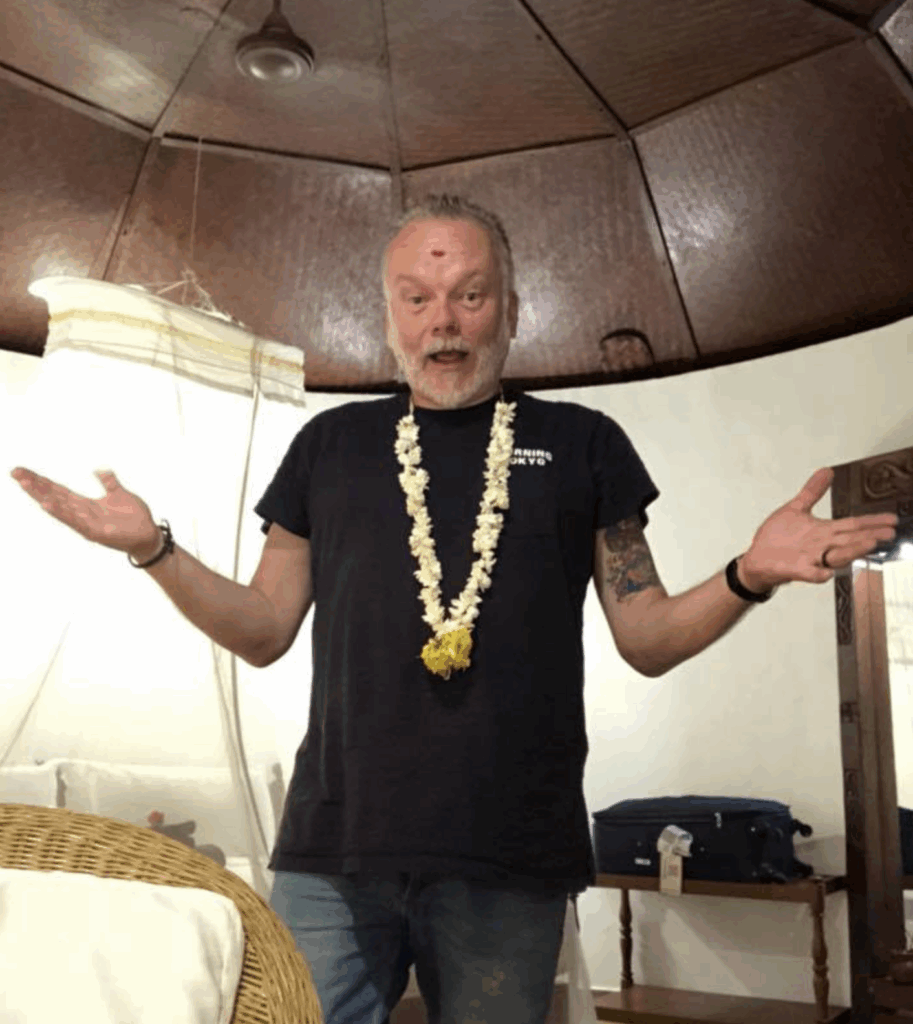
Me on my arrival 10th September 2018
Introduction
In this journal, I share my experiences from an Ayurvedic treatment centre in Manaltheeram, Kerala, India. I travelled there with the aim of improving my overall health, losing weight, and exploring ways to better manage my Type 2 diabetes.
Rather than focusing on the medical outcomes, I’ve written about the lighter side of the trip — the small, amusing observations and moments that made the experience memorable.
I hope you enjoy the read and thank you for joining me on the journey.
Ken Trevena
Chapter One: Arrival in Thiruvananthapuram
The plane touched down at Thiruvananthapuram airport at 07:30, after what can only be described as a sleepless four-hour hop from Oman. I shuffled off, heavy-eyed, bracing myself for the familiar dance of Customs and baggage claim. Customs, to my relief, proved painless. My bag, however, seemed to be on a personal pilgrimage. The conveyor belts and the location screens weren’t on speaking terms, and I stood for what felt like half my life before my suitcase finally trundled into view.
Bag in hand, I plunged into the arrivals hall and straight into a heaving sea of people. I scanned the crowd for the driver I’d been promised, but no familiar face—or sign—awaited me. When I asked an official-looking fellow where the drivers usually lurked, he pointed brusquely outside. The “sea of people” I’d just navigated was a mere pond compared to what was waiting beyond the glass doors.
At this point, I should confess that I’d already fallen victim to the infamous Indian head wobble—the noddy head, as I’d christened it. Earlier, when my bags were being checked, I asked the polite gentleman if I could proceed through. He told me “Go, go!”—yet his head seemed to be saying “No, no.” Exhaustion made me second-guess every movement, and after three rounds of contradictory signals, I finally twigged. Yes, meant yes, even when the head appeared to be saying otherwise. Mortified, I shuffled through, eyes fixed firmly on my shoes, pretending I’d just remembered something deeply important in my trouser pocket.
Outside, I was engulfed by dust, noise, and a thousand curious faces. Then, at last, I spotted my name scrawled on a battered board. My driver, Praveen, stood holding it with pride. In front of what felt like the entire population of Kerala, he handed me a single rose with great ceremony. I thanked him profusely—before, once again, searching for imaginary treasure in my pocket to disguise my embarrassment.
The drive from Thiruvananthapuram to Kovalam Beach began like any other: a man, a car, a road. Within minutes, though, I was reminded why I should never, under any circumstances, attempt to hire or drive a vehicle here myself. I’m no stranger to difficult driving conditions, but usually some form of rulebook applies. Here, the rules appeared simple: beep your horn and avoid collisions. Which side of the road you occupied was a secondary concern.
At one point, Praveen swerved across what looked distinctly like a dual carriageway, bounded happily over the central embankment, and sped twenty or thirty metres down the fast lane of oncoming traffic, missing cars by millimetres. Each vehicle replied with its horn, as if taking part in some great national conversation. “Why?” I asked, white-knuckled. Praveen smiled. “Strike today. Quicker this way.” Of course. A national strike. Lucky us.
Somehow, we arrived in one piece at Manaltheeram. My welcome there was as warm as it was bewildering: garlands of fragrant flowers draped over my shoulders, a red dot painted ceremoniously on my forehead, and, as the grand finale, a large green coconut split open in my honour. Naturally, I returned to rifling through my pockets, searching for something that wasn’t there, desperate to hide my awkwardness.
And so, I’d made it. Safe, tired, and a little bit traumatised. Treatment would begin soon, but for now, all I wanted was rest. Tomorrow, I told myself, would be another adventure.
Chapter Two: The German
Day Two began with my first official treatment. I found myself seated beside a kindly looking German lady of a certain age. Keen to make conversation, I asked where she was from.
“Bavaria,” she said.
“Ah, is that in the North?” I ventured, attempting cultural small talk.
Her expression barely flickered. “No. Bavaria is in the South. Hamburg is in the North.” The words were delivered with the precision of a train timetable.
I tried to recover by mentioning my six years working in Basel. “That’s near Austria, isn’t it?” I added, in what I thought was a conciliatory gesture. She simply looked at me. Silent. Unblinking. My mind, unhelpfully, supplied Hitler. I buried my eyes in my lap and resumed the now-familiar ritual of pretending to search for something in my trouser pocket.
The consultation followed. Two earnest doctors spent forty minutes poking, prodding, and asking questions in hushed tones before announcing my fate: my dosha was Kapha-Vatha. Treatment, they explained, would be tailored to this body type. I nodded solemnly, none the wiser.
Back in the waiting area, I found myself once again beside my German acquaintance. She greeted me with a cheerful, “You again!” Her smile reassured me. Having worked with Germans before, I knew they sometimes sounded abrupt when in fact they were merely being efficient.
It was at this point that my peculiar shortcoming resurfaced. Cathy, my long-suffering partner, insists I suffer from a mysterious condition: I cannot reliably distinguish middle-aged women from one another unless they possess some unusual feature—or happen to be eccentric enough to leave an impression. Shops, local events, even passing acquaintances—I’m forever being greeted warmly by people I don’t recognise. Cathy fields emergency calls from me where I breathlessly describe someone in aisle three who clearly knows me. It’s embarrassing, but also hilarious.
This German lady, I realised, would blend into the blur unless I devised a system. Salvation came in the form of her feet: neatly painted red toenails and a large bunion on the left one. From that moment on, I resolved to identify her by stealthy glances downward. I’ve since greeted at least four similar-looking ladies by surreptitiously checking their toes.
On this occasion, however, we sat quietly, surrounded by an atmosphere of hushed reverence. The staff moved silently about the hall, the “treatment specialists” circling with the solemn grace of lions. Suddenly, one of the doctors approached, flanked by a lion in a leather apron.
“Looks like zey are coming for you,” my companion whispered, clearly amused. Hitler again flashed across my brain.
The doctor held out a copper cup and instructed me to drink. Inside: half a pound of melted ghee, enriched with mysterious herbs. To my tongue, however, it tasted exactly like half a pound of melted butter. Somehow, I swallowed the lot, suppressing a gag, and returned the vessel with what I hoped was due reverence.
When I glanced at my German neighbour—let’s call her Eva—she looked deeply curious about my fate. I stuck out my tongue and whispered, “Yuk.”
Eva exploded. In that sanctified silence, she shrieked and howled with laughter. Her outburst nearly set me off too, but at that moment I was whisked away for treatment, her cackles echoing behind me. Five minutes later, I could still hear her. It absolutely made my day.
The treatment itself involved an extraordinary quantity of oil, alarming levels of nakedness, and nearly three hours of slippery manoeuvres. Exhaustion from the flight overtook me and I nodded off halfway through, which may or may not have been part of the therapeutic design.
Same again today, they tell me, so I’ll try to stay awake and pay more attention. For now, though, I’m off to yoga—quite excited about it.
Chapter Three: Yoga, Oil, and Other Horrors
Yoga was, in a word, a washout.
I arrived ten minutes late to the hall, only to find twenty cross-legged people hovering in a state of semi-levitation, radiating serenity and chanting in tones so soothing I almost felt myself float away just watching them. I lingered in the doorway, torn between awe and panic. Should I whisper, “Hello, is this the beginners’ yoga class?” And to whom? The whole scene felt less like a workout and more like intruding on someone’s funeral and asking if I could peek at the body for research purposes.
Naturally, I did the only sensible thing: rummaged in my pocket for nothing and shuffled away, studying my shoes with great interest. Later, I discovered that I’d blundered into the Advanced Meditation class. Wrong place entirely. Still, fascinating to observe.
Next came another Ayurvedic “massage,” though the word hardly does it justice. Imagine, if you will, a killing chamber straight out of Hostel I or Hostel II. Add a man in a leather apron, gallons of oil, and clients who are 98% naked, and you’ll have the general idea.
The ritual always begins with the ceremonial drinking of a quarter-pint of warmed clarified butter. My executioner—sorry, therapist—then escorts me on a three-minute walk while I desperately try not to disgrace myself by ejecting the butter prematurely. Back in the chamber, I’m issued a pair of paper pants, perched on a stool, and subjected to a head massage involving a steady stream of oil. My hands and feet get dusted with pungent powders, and then the rest of my body is slathered in medicated oils until I resemble a greased eel.
From there, I’m transferred to the rubber table—yes, it sounds like a fetish film, and yes, I feel like an unwilling star. For two hours, I’m pummelled, rubbed with gauze herbal poultices, and marinated in hot oil until I’m practically deep-fried.
The grand finale is something called Nasya. My head is tilted back, and oil is poured straight into my nostrils to “reach the brain” and cleanse me of lingering impurities. What it actually does is burn my nose and throat with the fury of molten lava. I have four more of these delights to endure before my detox stage is complete.
Mercifully, at the end, a coconut is ceremoniously slaughtered, it’s cool milk soothing my scorched throat. I am then released—oily, dazed, and faintly smelling like a tandoori marinade—to sip tea and read the newspaper before staggering home for a shower and lunch.
A glance at my new treatment timetable nearly finished me off. The “balance phase” of my Panchakarma begins on the 17th of October and, rather ominously, is titled Purgation. The programme includes three elements: Vamana, Jalaukavacharana, and Anuvasana Basti. I Googled all three, and I genuinely cannot decide which promises the most fun. None of them, I suspect, will involve cocktails by the pool.
Anyway, breakfast beckons.
Chapter Four: TukTuk
Another yoga fail. I managed, yet again, to go to the wrong place. Today, though, I am determined to succeed.
On the plus side, I now have two friends: Eva—who, as it turns out, is actually called Monika—and Kieran, an Irish-American with a dry wit. We’ve taken to eating together and mercilessly mocking the Russian ladies who seem to be the most miserable people I’ve ever encountered outside of Russia. Actually, wait—no. They were miserable in Russia too. Except in a little town called Suzdal, where they were unexpectedly warm, full of hope for the future, and welcoming to tourists. Granted, they were also selling T-shirts of Putin stabbing Obama with a sword—but still, it was a start.
Yesterday brought shopping adventures. I had a cotton shirt tailored for £12.77 and, more questionably, a pair of prescription glasses for £61.75. The experience left me uncertain about their provenance. The optician’s was closed when I arrived, but I noticed the banana seller from next door slip around the back and re-emerge inside wearing a white coat, greeting me with a flourish—very Mr Benn.
He presented me with an array of frames. I chose a modest blue pair. “That will be 1,800 rupees,” he declared (about £19). I stuck my fingers through the empty frames, making it clear I wanted actual lenses. Negotiations resumed. I handed him my battered old pair, scratched to oblivion, and said, “Like these.” He peered through each lens in turn, did some quick arithmetic in his head, and finally asked: “OK—bad, medium, or very good?”
Naturally, I chose “very good,” though I insisted on an eye test. This he performed reluctantly, using a Hindu eye chart of bewildering symbols. After much pointing, squinting, and gesticulation, we arrived at something resembling a prescription.
Next, my trusty TukTuk driver was tasked with taking me to a nearby ATM. Simple enough, I thought. He, however, interpreted this as: “Please, drive me 25 kilometres like a man possessed to a distant village so I can meet your nephew and purchase spices.”
Each time I pointed at a perfectly serviceable ATM, he waved me off. “Next place, better one,” he muttered, accelerating madly through traffic. We spent two hours ricocheting through towns and villages. In the end, the ride cost me £3.19, and, truth be told, I rather enjoyed it.
Today’s tasks: buy a SIM card, since WhatsApp and FaceTime barely function even with a VPN, and submit myself to a treatment ominously titled Shirovasti. This involves wearing an oil-filled palm-leaf hat into which two litres of liquid are poured. The doctors assure me it will make me “very clever indeed.” We shall see.
For now, though, it’s time to pretend I’m going to yoga again.
Chapter Five: Yoga at Last
Yesterday, I finally achieved yoga. Yay!
Determined not to repeat my catalogue of failures, I arrived early at the hall. A large German lady was already setting out mats. I greeted her politely and asked if this was the beginners’ class and what I should do. She waved me in with calm authority: “Find a mat, a towel, and set up wherever you like.”
I chose the farthest corner from the front—what I believed to be the optimum position for minimal humiliation. Within ten minutes, the Yogi arrived, all smiles and serenity. “Just watch me and follow,” he said. Simple enough. As more people drifted in, some began gentle stretches while one particularly keen woman launched into handstands and full-body tremors. Not necessary, I thought.
The session began with chanting—deep Oms that vibrated pleasantly in the chest—before moving on to circles with head, arms, and feet. Then came the trickier bits: nose-to-toes contortions (not happening), slow-motion press-ups, spine-twisting manoeuvres, and leg lifts that had me scanning for escape routes. Somehow, though, I made it through. Even the balance pose—standing on one leg with the other perched on my thigh—I managed without toppling, unlike Mrs “Stand on Her Head.” One point to me, I think.
There was, however, one unforeseen consequence of my carefully chosen location at the rear. I’d meant to hide my clumsy wobbling from the gaze of others. What I hadn’t considered was the view that presented itself to me. A view, let’s say, usually reserved for God—or a gynaecologist. Today, I shall be sitting at the front.
Elsewhere in life, I gave my TukTuk friend another chance to redeem himself. First, he delivered my new prescription glasses. “Novelty” is perhaps the better word, as they turned out to have a kaleidoscope effect I hadn’t requested. Specsavers are now sending me my proper prescription, and I’ll return to the banana-selling optician later with the correct numbers.
Then, to the matter of the SIM card. Enter Rajesh, a cheerful fellow who took my 1,800 rupees, my passport, and a hurried photograph before leaping on a motorbike and vanishing into the traffic. Nobody seemed to know where he’d gone. I announced that I would wait and be very angry if he didn’t return. A flurry of phone calls followed, and—thankfully—Rajesh reappeared after fifteen minutes, triumphantly waving a police stamp. Apparently he’d been off to register my SIM. Or perhaps to clone my passport.
We laughed, shook hands, and all was well again. He inserted the SIM, promised it would activate in an hour, and sent me on my way. Fifteen hours later, I’ll spare you the details, but suffice to say I’ll be seeing Rajesh again shortly.
Meanwhile, I appear to have developed a cold—or possibly leprosy, or something worse. The doctors assure me it’s nothing sinister and have prescribed special medicine alongside a cup of medicated coffee. The coffee is so potent it’s taken my mind entirely off my illness by rendering my tongue numb. The chief ingredient appears to be naga chilli. Nice one, Doc.
Chapter Six: Oil, Russians, and Near-Death in a Tent
No yoga today, by doctor’s orders—apparently leprosy (or whatever I currently have) is best treated with rest. Truth be told, I was rather relieved. I ache in places I didn’t know existed.
My inability to recognise middle-aged women struck again at dinner. I approached Monika, or so I thought, and asked if I might join her. She smiled politely as I sat down—only for me to realise, mid-paneer, that this was not Monika at all but a Russian woman with no English whatsoever. Conversation was, predictably, stilted. I bolted down my chapatti in record time, praying she wouldn’t get tipsy on coconut milk and mistake me for a suitor. Really, I’ve only myself to blame. Rule number one: always check for bunions before talking to strangers.
I resolved instead to find Kieran for a proper chat. He leaves on Monday, after three long weeks. He’s had enough. Swimming gifted him an ear infection, and now he tilts his bald head at me, good ear straining for sound, while we appear to the casual observer like a pair of gurus deep in yogic communion.
Today’s treatment, at least, was magnificent. We began with the usual air massages, followed by something called Dhanyamla Dhara. For a full hour, I lay in rotation—back, left, right, front—while copper vessels poured half-litre after half-litre of steaming herbal oil over me. By my rough calculation, I was basted in some ninety litres of liquid. Like a Sunday roast.
Next came forty-five minutes of herbal-bag pummelling, then a vigorous deep-heat rub, and finally, the pièce de résistance: fifteen minutes in a tent attached to what looked like a gas-fired kettle. Eucalyptus-laden vapour was piped directly at my chest, while I contemplated all the inventive ways I might perish—carbon monoxide poisoning, a syphon malfunction spraying boiling water, or simply asphyxiation. Mercifully, none of these came to pass. For today, anyway.
Apparently, tomorrow’s session will be similar but with the bonus of a herbal bath at the end. Something to look forward to, I suppose.
One subject I haven’t properly addressed is the nakedness. We’ve gone from towels, to thongs, to paper briefs, to… nothing. At all. I’ve resigned myself to going with the flow, trusting that the bromide levels in the tea are sufficient to prevent scandal or sudden departures from the centre.
In lighter news, I bought Cathy an Indian flute and came dangerously close to acquiring a sitar for myself. Negotiations were going beautifully until I noticed the case was taller than I am—hardly practical for hand luggage. Fifteen years ago, I owned a sitar and took lessons in London. I loved it. Then it broke, and I gave up. This time, though, I’m determined. That sitar is coming home with me somehow.
Right then. Off to yoga.
Chapter Seven: Chits, Chairs, and Mr Benn
One thing I’ve noticed about India: there is a quiet obsession with order, serial numbers, and chits. Everything at the centre—chairs, cupboards, mirrors, bedside tables, even lamps—has its own serial number proudly embossed in Dymo tape, as if each object has been catalogued for eternity.
The same spirit prevails in the marketplace. I watched a woman purchase a one-metre red measuring tape and a quire of A4 paper. In a British corner shop, this would warrant a cursory glance and perhaps a muttered “That’ll be 70p, love.” Not here. Not in Kerala.
The first problem was that the serial number for the tape measure could not be found. A small regiment of staff mobilised, eventually locating a box stuffed with multicoloured tape measures. After much head-nodding and murmured debate, a solution was agreed upon.
Next came the paper. Each sheet was painstakingly counted. I found this deeply therapeutic—until the cashier declared the tally incorrect and made the poor girl count again. I believe the final number was 28. A receipt was then written out, handed to the senior cashier, stamped, handed back to the lady, and finally passed to the junior cashier, who relinquished the goods.
The whole process took longer than it would to build a small shed, and I was utterly transfixed. I could watch such systems unfold all day long. I once paid a boy called Keith ten pence at school to count the pages in a book for me. I’ve said too much.
Later, I returned to the optician to complain about my novelty kaleidoscope glasses, this time armed with my Specsavers prescription. Mr Benn examined it gravely. “These are progressive lens,” he announced. “What you bought is reading lens.”
I tried to remain diplomatic. “Yes, perhaps I should have given you more detail at the start. But surely the fundamental point of reading lenses is that you should—at the very least—be able to read with them?”
To illustrate, I picked up a chart, donned the spectacles, and pulled my very best “I can’t read this” face. At that moment, Mr Benn seemed to revert back into the banana vendor he had once been. His English evaporated, replaced by smiles and noddy heads. I departed, none the wiser.
On the way back, I noticed a dentist and thought, “Why not?” I went in for a simple descale and walked out having had a descale, a polish, whitening, and one filling. All for £18. Time will tell, but the equipment was modern, the clinic spotless, and the other patients looked reasonably healthy.
Back at the centre, treatment continued with a herbal bath following the usual Ayurvedic marathon. I began face down with Joseph, my regular chap, massaging away. By the time I rolled over, Joseph had acquired two assistants who joined in with what felt like a brown, gritty full-body polish. I was then escorted to Shower Block H, where one of the assistants casually hosed me down. “Jiggle here,” he instructed, pointing toward the chap and chuddies. I suppose I should be grateful he didn’t attempt the jiggling himself.
And so, as you can probably detect, I have changed.
Chapter Eight: Uncle Keikei
One week in, and I’m still alive. The mozzie net is perfect for keeping the little blighters at bay, but of course they found their opportunity when I slipped out to the loo in the night. From now on, I’ll have to spray myself too.
Today I’ve been reflecting on my TukTuk driver, Keikei. He’s a wiry man with a sharp sense of humour, much liked by his fellow drivers. His “fellows,” incidentally, consist of two other taxi men and a murderous-looking Neanderthal who lurks outside the centre bellowing at anyone or anything that will listen.
The other drivers cannot, for the life of them, understand why I consistently choose this skinny TukTuk pilot over their own “luxury” 20-year-old Datsun Sunny, which smells faintly of long-forgotten dairy products. The answer is simple: I like Keikei. He’ll happily drive me for miles, and when we return, he never asks for money. I give him a few hundred rupees anyway, and he beams.
I suspect he’s just delighted to have a foreigner in his TukTuk. Whenever we stop—whether it’s for an ATM, a fabric shop, or a supermarket—he invariably pulls over to ask directions. At first, I thought he genuinely didn’t know his way. But after watching the faces of people we approach—shock and delight when they clock me sitting in his cab—I’ve realised the truth: I am his trophy. He parades me about as proof of his international clientele, a kind of human endorsement. It’s hilarious. I may even start calling him “Uncle” for effect.
He’s been pestering me to join him on a trip to the Backwaters and to visit the elephants at Kottur. The centre runs its own organised tours—INR 2,700 (a princely £30)—but I’ve agreed to go with Keikei instead. With him, it’ll be about £5, infinitely more flexible, and blissfully free of grumpy Germans and Russians elbowing their way to the best view. I know which I’d prefer.
When I leave, I plan to give Keikei a generous tip, along with some bags of dog food for my favourite stray. He’s promised to keep feeding the dog until the supplies run out. He’s a good soul, and I trust him to keep his word.
Chapter Nine: Purgation and a Sarod
Today marks the start of the purgation phase of my treatment. The word alone inspires dread. My diet now consists exclusively of rice water, rice gruel, and rice with steamed vegetables—culinary variations on a theme—accompanied by mysterious potions said to “release toxins from the body.” I await the results with cautious optimism, though I suspect the “toxins” in question are enjoying themselves too much to leave quietly.
With energy low and options limited, I haven’t achieved much beyond surviving. Still, there has been one notable success: I bought a sarod. For the uninitiated, the sarod is a Hindustani stringed instrument, cousin to the sitar, with a rather formidable nineteen strings. It is one of India’s most iconic classical instruments, revered for its deep, resonant tone.
At present, my triumph is limited to the tuning stage, which is rather like trying to keep nineteen opinionated cats in line. Still, I am convinced that within a week I shall be producing something vaguely musical—or at least recognisably different from the sound of furniture being moved upstairs.
Otherwise, it has been something of a dull day. I may walk a few miles along the beach, in search of something to amuse myself. Or at the very least, to remind myself there is a world beyond rice gruel.
Chapter Ten: Doctors, Diets, and Burning Ears
Yesterday was a washout thanks to the sudden arrival of a tropical storm. I surrendered to it with a movie and a study afternoon—the “study” being my ongoing battle with the sarod. I’m delighted with it. It produces the sound of a sitar without all the logistical nightmares of owning one. Nineteen strings are a challenge, but I’m beginning to coax something approaching music from them.
Yoga, too, is improving. Relatively speaking, of course. I’m still more wobble than warrior, but I now find myself genuinely enjoying the sessions. The treatments as well—most of them. This mornings was an exception. I was told to lie down, relax, and open my mouth. The instruction, it turns out, was completely redundant. My mouth would have opened anyway, involuntarily, given the nature of the procedure. Suffice to say, the area being “treated” was located nowhere near my mouth. Quite the opposite, in fact.
I also had my Day Ten review with four doctors. Three peppered me with questions, while the fourth simply stared at my face for the entire consultation. I had an overwhelming urge to develop a twitch, just to see what would happen. It felt less like a medical check-up and more like a soul audit. Unsettling.
Nevertheless, they declared themselves satisfied with my progress. The catch: I’m now on a special diet for the remainder of my stay. Considering the regular food is already spectacularly bland, I dread to think what the “special” version will be like. I suspect the peanut brittle I’d been secretly nibbling from my stash drawer betrayed me. The maid must have dobbed me in.
The day began early, with treatment at 06:45. It involved the usual smorgasbord of oils and poultices, plus herbal foot and hand baths, followed by smoke blown into my ear. The apparatus resembled a cross between a Van de Graaff generator and a toilet plunger, filled with burning charcoal. The effect was hot, noisy, and smelly—and yes, it burned my ears.
This afternoon, however, brings a change of pace. I’m off to the Backwaters. Everyone assures me this is a good thing. We shall see. Pip pip.
Chapter Eleven: Backwaters, Boats, and the Swiss
Today’s excursion was a boat trip on the backwaters, offered free by the centre. My companions were Monika, a Swiss lady, and a Spanish woman. The Swiss has apparently been here eight times. Eight! She announced this would be her last visit as she was “getting too old.” She also had the gall to claim that Switzerland’s wealth comes from the hard work of the Swiss people, and not, say, from being the world’s favourite bolt-hole for dodgy cash and tax avoidance.
I couldn’t resist mentioning that I had worked in Switzerland for six years and, in my experience, it was the Germans and Israelis who were the hardest workers. That was the end of our conversation—probably forever.
The boats themselves were disappointing: shabby little things with fibreglass seats, nothing like the beautiful wooden houseboats I’d been hoping for. The first waterways were littered with floating plastic bottles and general detritus. Someone really ought to make a bit of an effort, I thought grimly, checking my watch after only ten minutes.
It did improve as we went deeper into the rivers. Birdlife appeared kingfishers darting like jewels, eagles soaring overhead. For a moment, it was rather wonderful. Then the boat ran aground, and I found myself calculating the trajectory required to lob my iPhone safely to shore should disaster strike. Sadly, such drama was unnecessary. The only real entertainment would have been listening to the Swiss lady and the useless Spanish woman raising hell while attempting to drown in three feet of water.
Monika, I’ve noticed, is something of a serial complainer. She can’t drink the mandatory Thai basil and cardamom tea because it gives her indigestion. She demanded a better room because she couldn’t abide the fat Russian ladies smoking and chatting into the early hours. She told off a Sikh couple for using a mobile phone near the yoga area. And she doesn’t like oil treatments—prefers hot milk instead. No wonder she’s recently divorced after thirty-six years. One can only imagine the state of her ex-husband.
So, the boat trip was a dud, and because it was organised, I couldn’t even escape. Today, however, promises better: Keikei and I are TukTuking thirty kilometres to the Neyyar Dam, and perhaps an elephant sanctuary, provided the animals are treated decently.
A fresh batch of inmates arrives at the centre today. I look forward to watching their enthusiasm gradually drain away.
Chapter Twelve: Elephants, Buses, and the Swiss
Today’s adventure with Keikei took us to the Neyyar Dam, the so-called Elephant Sanctuary (more like a prison), a Dhanwanthari Ashram, a crocodile and deer centre, and finally a rubber plantation.
The elephant stop was the low point. All of the animals were tethered, their “lush surroundings” little more than scenery they could look at but never touch. Two bulls in particular looked miserable—one of them swaying his head side to side in that tell-tale way of animals who have nothing left to do. I’m no expert in elephant body language, so I filmed a bit of it to show others, but the whole place felt oppressive and claustrophobic, even though we were technically outside. I’d seen enough and suggested to Keikei we move on. He didn’t quite understand why I didn’t like the star attraction of his tour. Or maybe he did and just didn’t want to admit it.
Soon after, the heavens opened. We waterproofed the TukTuk, I put my headphones on, grew quickly bored with Anoushka Shankar, and settled happily into two albums of Crosby, Stills, Nash & Young. Honestly, the perfect soundtrack for monsoon-TukTuk travel.
At around 4:30 I suggested we head back. Thirty-five kilometres of hair-raising driving awaited us, and I wanted to make it before dark. Easier said than done. At one point I was so convinced Keikei had nodded off—heading straight towards an oncoming bus—that I tapped him on the shoulder to make sure he was conscious. My other option was to leap out and let fate take its course. Luckily, he swerved at the last second. Unluckily, the motorcyclist beside us had an impromptu off-road scrambling lesson. Remarkably polite about it too—just a mild shake of the hand in Keikei’s direction, as if to say “Steady on, old chap.”
We stopped for chai to give him a boost. I also donated the remainder of my “hot things” (mint polos), which he enjoyed rolling around his mouth and which, I swear, helped his concentration. We eventually made it back, the last ten kilometres in darkness, and I gave him 2,000 rupees. Every time I ask what I owe, he just says, “You choose?” It’s hit and miss—I don’t want to insult him, but I’m fairly sure he exaggerates the fare to the other drivers, because they always glance over when we settle up, and he’s lightning quick to stuff the cash into his wallet.
Later, in the restaurant, I spotted the Swiss lady again. This time she had a clone with her, gliding from table to table, pointing out “fascinating” details in the décor which her companion seemed to lap up. The manager clocked her restlessness and began showing her every available table. Too large. Too small. Too windy. Too near the door. Too near the band. Out of twenty tables, none met her exacting standards. You’d think after eight trips of three weeks each—168 days—she’d have found a favourite by now. I found mine after three meals.
Eventually, she settled at a table for four, only to summon the manager three minutes later and request the removal of the lightbulb above her because it was “too bright.” Mercifully, he refused, pointing out that other diners benefited from it. Otherwise, I might have had what the doctors call a “sense of calm failure.”
It’s car crash people-watching, but irresistible. I now find myself scanning the restaurant for her, just to enjoy being outraged.
Chapter Thirteen: Bitter Gourd and a Crow with a Fish
I’ve resumed the dreaded diet. It seems to consist mainly of dal-like soups and chapatti, which isn’t so bad—until it’s paired with pavakka thoran. The star ingredient of this dish is bitter gourd, which, according to the Ayurvedic gospel, contains a train of important nutrients: iron, magnesium, potassium, vitamin C, more calcium than spinach, more beta-carotene than broccoli, and more potassium than a banana.
Wonderful. But here’s the problem: it tastes truly, irredeemably horrible. Whoever first put this in their mouth and didn’t spit it out screaming must rank very high on the masochist spectrum. Honestly, if you want the benefits, take a multivitamin tablet.
Naturally, I’m now suffering digestive distress. I blame the bitter gourd entirely. I managed some porridge this morning and was sipping coffee when a crow landed on my table. I glanced up briefly, then returned to my book (Confessions of a Sociopath, gripping stuff). Out of the corner of my eye, I noticed the bird had something in its beak. My first thought: “Damn, it’s pinched my toast.” Then it dawned on me—I hadn’t ordered toast.
The crow hadn’t stolen anything. It had brought me a fish.
Yes, a fish. About the size of a vibrator (or so I imagine). Where on earth does a crow catch such a thing? And what, precisely, did it expect me to do with it? Its beak was completely unsuited for tearing flesh, so perhaps it wanted me to cut the fish into bite-sized portions? It perched there at the end of the table, tilting its head, the fish flopping between quarter-to-three and ten-past-four like some grotesque clock hand.
Of course, I hadn’t brought my phone to capture the scene. Annoyed, I went back to reading.
Today I’m taking it easy—beach, book, and no treatments. I’ll tell the doctor so. Yoga, however, I will attend. Yesterday I skipped it when the hall was overrun with a new Zug Wagen of German arrivals, all pointing, chatting, and loudly circling like tourists at a zoo. Yoga had been moved to the outdoor platform, but I didn’t fancy becoming their afternoon entertainment. I slunk away with my book instead.
On my way back, I passed the session still in progress. The group lay in blissful relaxation while the Yogi glided among them. At about fifty metres, his eyes locked on to mine. Exceptionally dark-skinned, his whites shone like beacons, and they fixed on me with unnerving intensity. For a moment, it felt as if his face was inches from mine. The message was wordless but perfectly clear: You won’t miss my class again, will you?
No. I don’t think I will.
Chapter Fourteen: Jellyfish, Jaffa Cakes, and Justice
Not much to report today—I’ve been feeling a bit under the weather and spent most of it in my room. I did, however, take my sarod to a courier company to ask about shipping it back to the UK. Their answer: INR 40,000 (£450) plus the cost of building a wooden crate. Bollocks to that. I’ll drag it home myself, nineteen strings and all.
Later, I went for a walk along the beach and briefly considered a paddle—until I noticed dozens of purple jellyfish washed up along the shore. Luckily, before venturing in, I spotted hundreds more floating just offshore, their tentacles poised for action. Then I realised: no one else was swimming. Always look for the signs, Kenny. Always look for the signs. We’re not in Kansas anymore.
I popped into a beach shop for peanuts and water. The nice lady behind the counter, and what I assume was her husband, immediately tried to upsell me everything in sight. I spotted a pack of Jaffa Cakes—yes, Jaffa Cakes, in India! —and asked if they were orange. The man said yes. The lady said no. He snapped at her. She was right. They were strawberry.
Strawberry Jaffa Cakes. What in the name of Hades’ plimsolls were they thinking? Burn them in hell, I thought. But credit to the lady for honesty. From that moment, I spoke only to her. This, in turn, prompted her husband to dig furiously through sweet jars, snapping off chunks and thrusting them at me with his (hopefully) clean hand. I politely declined, explaining I was on a strict regime. He got shirty. I paid and left.
Or so I thought. He ambushed me again, sprinting ahead around the dunes to intercept me, this time armed with stone-carved elephants. Out of politeness, I looked at a few. “INR 2,500,” he declared (£30). “Not now,” I said. “I’m just exercising.” He got shirty again, shouting: “Buy now! You won’t come back!”
“You’re right,” I told him. “I won’t come back. Not to you. Because you shout. People don’t like it. Idon’t like it.”
If looks could kill. For the record, those same elephants sell inland for INR 350 (£3–4).
The ones I do feel sorry for are the frail women selling fruit. I’ve stopped telling them “I can’t, because of my diet.” Instead, I buy a guava or papaya and leave it in the restaurant for the Germans or Swiss to marvel over.
Speaking of the restaurant, one more humiliation to share. Last night I endured a meagre, tasteless supper of what could best be described as rubber shavings and grit. As a reward, I treated myself to a big red banana. Just as I raised it, three doctors ambushed me. The small, fat one beamed, loudly proclaiming, “I am glad to see you eating your diet. HOW IS YOUR DIARRHOEA DOING?”
If only he’d spoken up a little louder—perhaps the lady twenty tables away didn’t quite catch it.
To add insult to injury, he then declared bananas bad for my condition and promptly confiscated it. In front of the whole restaurant. Diners stared as I slunk away. I longed to whisper:
“Help me. I’m a prisoner here. I came just like you… five years ago. I’m only twenty-three. Get out while you still can.”
Chapter Fifteen: Reflections, Pineapples, and Aerials
I haven’t said much yet about Kerala itself, but it really is a beautiful and spiritual place. There’s a peace here that seeps in when you swing in a hammock, read a book, or simply turn down the volume of the world outside. It’s a depth of contemplation I rarely achieve at home, where everyday life intrudes at every turn.
Here, I find myself thinking about how remarkable it is that we all just carry on, no matter what life throws at us—even when it feels impossible. I think about how strong Cameron and Amélie were during those two and a half years when we ultimately lost Valérie, and how, somehow, we kept the plates spinning and even managed to laugh in the face of it all.
I think about why I travel so much with them now, taking them to different countries whenever I can. Some might see it as extravagant, but it feels like necessity. Valérie had the bug too—leaving France at sixteen to work as a waitress in London so she could fund her travels around Europe. Greece was always our favourite, which is why I took the kids there this summer. Amélie engineered it: the three surviving Trevena’s holidaying with their respective partners. It was strange, but it worked. We had a fabulous time.
The point is: we do stuff. We’re lucky enough now to afford to, but it wasn’t always that way. I know what it’s like to have nothing—or less than nothing. Credit card debt, rent arrears, store cards, all the usual traps. That’s why I believe so strongly in making experiences rather than buying possessions. I even posted an article on Facebook recently— “Four Reasons to Spend Money on Experiences, Not Possessions”—because it captures exactly what I feel. If you want an interesting life, you must go out and make one. I’ve always tried to do that, and I owe it to Valérie to pass that spirit on to the kids. I’m sure she approves. She hasn’t sent me any signals to the contrary.
Anyway—enough of that. Today marks the start of my third and final week of treatment. I’m religiously attending yoga now, lest the Yogi’s white eyes return to haunt my dreams.
Monika suggested I try Somatheeram, the sister centre, because the restaurant there was better. She was right. First dish on offer: stir-fried pineapple with onion, carrot, and peppers. Delicious. I’d shared a taxi with a French woman and her husband, but upon arrival she seemed convinced I was with them, chattering about where “we” would sit and what show “we” would see. I slipped away when she was distracted by a staff member, only to be hunted down at dessert. “You must come outside to see the Kathakali performance!” she cried.
I ducked into the loo. Emerging cautiously, I spotted her right at the front of the stage, clapping away, her wiry hair standing out like a TV aerial. Even her husband had deserted her. I resolved to have a banana and sneak out the side door.
Just as I was about to leave, the heavens opened. Performers and audience alike dashed for cover. Everyone except her. She sat beaming, drenched, clapping like a mad cat, aerials drooping around her face. I’m getting better at spotting nature’s warning signs.
This morning brought another crow-related disaster. Having grown tired of the stodgy bread here, I’d bought myself a pack of dry French toast, slimline and entirely in keeping with my diet. I set up at a table by the sea, book in hand. Then—wham! —a crow dive-bombed the table and disappeared with the entire packet.
It reminded me of a scene years ago in BELGO on Clapham High Street. A roller-skater swept past the outdoor tables, snatching bags, phones, anything left unattended. One poor man lost his phone, and the only thing he could think to shout was: “It’s pay as you go anyway, you fucker, and there’s no credit left!” Which was technically true, but hardly helpful.
As for my crow thief, I longed to yell after it: “The packet’s not even open! You’ll never get what you want!” Instead, I sat back down, contemplating my poor choice of table.
Chapter Sixteen: The Sikh, the Singing Bowl, and the Mosquito Battalion
This morning, I instructed Keikei to take me to the Sikh who sells antiques. Monika had told me about him—an astrologer, very wise, very nice. Keikei, of course, immediately tried to redirect me to his nephew’s shop for “nice spices and stuff.” I held firm. “Take me to the Sikh! I need to see the Sikh, inshallah!” After some grumbling, off we went.
The emporium was a treasure cave of deities, presided over by a giant Kali with tongue lolling. From behind this forest of gods emerged the Sikh himself—tall, imposing, booming: “Welcome, welcome!” I instantly felt at ease.
I told him I wanted to buy little Hindu idols for friends and family. We sat together, and he asked me to describe each recipient—their age, sex, personality. For Amélie and Cameron, then Cathy’s kids Sam, Leo, and Felix, I gave little portraits. After each description, he nodded decisively: “Ganesha. Shiva. Saraswati—yes, definitely Saraswati.” It was like spiritual matchmaking.
Then he leaned back, eyes twinkling. “Five beautiful children? You and your wife are very fertile. Great virility.” He handed me two colourful tassels representing this supposed fabulousness. I accepted his diagnosis, kept my mouth shut, and basked briefly in my godlike status.
I also spent a good half-hour choosing a Himalayan singing bowl, striking dozens until I found one that resonated perfectly with my Sahasrara, Anja, and Visuddha chakras (Google them). He even demonstrated a trick with water, showing how the bowl’s vibrations mimic the fluids in our bodies. (No, Tom—not that way.)
We struck a deal, and he packed everything neatly. He handed the bags to Keikei, who shot me a look that said, I’m not your bloody porter. The Sikh then asked, “How is your driver?” I replied, “He’s the best driver in Kerala.” Keikei beamed a toothless grin, shoved the bags in the TukTuk, and said, “I put bag in. You come.”
Once on the road, Keikei announced, “We go for photo, next place”—which is his code for I’m going to drive you around until you lose patience and beg me to take you home.
This time his mystery tour took us to Vizhinjam, a bustling seaport alive with mosques, colourful fishing boats, straw-roofed hotels, and, for good measure, copulating goats. From there we visited a temple carved from stone. I wandered off to photograph it, but when I turned around, Keikei was hobbling back to the TukTuk at speed.
I lingered to photograph an interesting tree—and that’s when five enormous mosquitoes, presumably already at the digestif stage of their banquet, descended upon me. In a panic, I performed the standard response to stepping on a landmine or being mauled by a predator: I leapt fifty feet into the air and scattered in all directions at once.
Back at the TukTuk, ready to scold him for not warning me about the local wildlife, Keikei simply shrugged. “Mosqies?” he said. Then, naturally, he drove me to his nephew’s shop for Tiger Balm and spices.
Chapter Seventeen: Pass the Expert
Another new batch of Jerries has arrived, all starry-eyed and pointing out “interesting” things to each other. I’ll never quite understand the European obsession with this pastime. And I say that with some authority, having lived in Switzerland and France between 2009 and 2015.
It wasn’t by choice. Redundant at 45, I had little option but to take a job abroad or risk losing the house. So for nearly seven years I lived and worked among Europeans, and I can confirm: they love nothing more than pointing, nodding, and holding earnest discussions about the most mundane things.
Case in point: yesterday’s fresh-faced Germans. They clustered at a table, one chap gesticulating wildly at the roof beams, explaining how the apex logs were bound with rope to give the roof its strength. Everyone else looked politely fascinated. Then, as if on cue, another suddenly became a waterproof-leaf expert, explaining how rainwater runs from one leaf to another without ever breaching the structure. The roof man, now relegated, looked amazed.
On and on it went—ailments, food types, TukTuks—until they settled on the fishermen just offshore, toiling all night to bring home enough fish to feed their families. The “expert” baton passed smoothly between them, like a game of intellectual relay. My German is better than I thought, though I admit I may have been reading between the lines.
Irritating? Yes. Fascinating? Also yes. Imagine me at the pub with the lads, suddenly launching into a solemn lecture about the inner workings of a beer cellar—barrels, CO₂, delivery pumps. I’d be lucky to avoid a slap. And yet, this continental ritual of “Pass the Expert” is such compelling car-crash theatre that I can watch it for hours, right up until nausea forces me to retreat.
Meanwhile, Keikei treated me to what he promised was a “Botanical Garden.” I wasn’t expecting Wisley or Kew. But Kuzhipallam Botanical Garden turned out to be surprisingly orderly amid the usual chaos: thousands of bonsai trees (perhaps the largest collection in the world, or so it seemed), roses with names like Lucky Mummy and Barbara Streisand, and vast plantation nurseries tended by workers in umbrella hats that stretched for miles.
At the shop, I spotted buckets of brightly coloured stones labelled “.30 paisa.” I spent ages carefully selecting five perfect specimens—blue, green, yellow, red, orange. At the counter, a lady popped them into a bag and handed them to another, who promptly scooped up handful after handful, filling the bag to bursting. Turns out it was .30 paisa per kilo. My carefully chosen originals are now lost in a rainbow avalanche.
Not much of a day, really. Though tonight looks more promising: a Kathakali show. That’s the one with the green, clown-like, eye-dancing characters performing ancient court dramas. I’ve perked up already.
Chapter Eighteen: Scales, Demons, and Seafood
I’ve resolved to learn the sarod properly. No shortcuts. No dabbling. Just the boring way—relentless scales until I achieve some mastery, then, perhaps, freedom to develop my own fusion style. For this venture I shall recruit Angus. Between us we’ve amassed a pleasing arsenal of world instruments and odd skills, and surely, if fate is kind, we can produce something magical.
Last night I indulged in a Kathakali dance show. It was excellent: a classic tale of love, abduction, and vengeance. Man and woman fall in love. Demon steals woman. Man kills demon. Everyone lives happily ever after. The costumes, the painted faces, the eye-dancing—all utterly mesmerising.
Today is officially a rest day. No yoga, no treatments. Instead, I’ll venture into Trivandrum with a driver from the centre. I risk upsetting Keikei, but 25 kilometres on city roads in a TukTuk seems cruel and unusual punishment. A car and driver costs only £15 for four hours, with the added benefit of air-conditioning. Though, truth be told, I’ve become so acclimatised I haven’t used the aircon in my room once—€20 a day is reason enough.
Tonight I plan to dine at a seafood cookhouse: barbecued fish and prawns. Technically not allowed under my regime, but as they’ll be tandoor-grilled—fat-free and fresh from the sea—I’m calculating a low risk of Delhi Belly. Still, note to self: buy Imodium and codeine.
Not much else to report. A group of Japanese guests arrived yesterday. They are polite to a fault. No loud discussions about roof beams or waterproof leaves; they simply photograph everything and bow when greeted. I appreciate the Japanese way. At Actelion, when I worked in Switzerland, we had training on precisely how to bow, and how to present and receive business cards with due reverence. They are infinitely courteous—though I suspect they’d lop off your head for even the most minor cultural infringement.
On with my leisure day, then.
Chapter Nineteen: Palaces, Conkows, and KFC
Today I hired a driver and headed into Trivandrum to see the palace, art gallery, and temple. The temple barred me entry, and the palace and gallery forbade photography, so there’s nothing to show for it but words. Still, what really rankled was the rigmarole of being a “foreigner.”
At the palace I had to leave my shoes outside, then was charged to retrieve them. On top of that, I was required to pay for a guide who’s relentless, halting English commentary spoiled the visit completely. Every artefact was explained—badly—while the perfectly good English descriptions on the walls went ignored. The art gallery was the same, a woman trailing me like a banshee, screeching interpretations of every painting while I tried to admire them in peace. I told her I had no money and wanted to look around alone, as the locals were doing. No luck. She shadowed me to the end, still expecting payment. She didn’t get it.
The saving grace was the hordes of schoolchildren on outings. Ninety-nine percent were perfectly behaved, sneaking shy glances when they thought I wasn’t looking, pointing out the “white man” to their friends. The brave one percent would break ranks to shout “Hello mate!” and collapse into giggles when I replied, “Lubbly jubbly, Rodney!”
The palace grounds also boasted strange hybrid animals—donkey-cows, or “Conkows” as I christened them—bred solely to provide milk for the temple monks. Curious creatures, as if God had run out of ideas and decided to merge two half-finished prototypes.
I also nearly acquired a Royal Enfield Bullet 500. For about £1,000, I could buy one, register it to a local address, have it crated and shipped to the UK, then pretend it was my personal property abroad and dodge duty and VAT. With £500 for MOT and V5 paperwork, I could flog it for £5,000 and repeat the process until rich.
Of course, the sticky parts are: (a) the man keeps the bike and I never see it again, or (b) HMRC charges me with fraud. For now, it’s been filed alongside my “winning £5M on the lottery” fantasy.
I also visited a shopping mall. It was surreal, stepping from the chaos and clamour of India into marble-floored calm, piped-in muzak, and tidy rows of gleaming shops. After nineteen days of twigs, bark, and dust, I succumbed. KFC beckoned. I bought a Zinger burger.
And—I can hardly bring myself to admit this—I didn’t like it.
Now I’m worried. 😧😳
As penance, today I’m doing double yoga.
Chapter Twenty: Nehru Coats and the Battle for Alpha 1
My penultimate day. I asked Keikei to take me to a fabric shop so that my tailor could fashion a Nehru long coat—perfect for cold winter evenings back in the UK. Where did we end up? You’ve guessed it: at his bloody nephew’s again, with offers of spices and sundries. I insisted, “No, Keikei. Take me to the fabric shop my tailor recommended. I need the material. Inshallah!”
With much grumbling, we eventually landed in a Kashmiri shop. Beautiful clothes, no fabric. The shopkeeper pointed us toward another shop near Trivandrum—precisely where I’d tried to avoid going with Keikei, as city dual carriageways are clearly not his natural habitat. The next stop turned out to be a sari shop, also no good.
By now we were close to Trivandrum Mall, and I fancied a fresh juice and some dates from the Arabic deli, so we pressed on. It was immediately apparent that Keikei was out of his depth, flustered in the city traffic. Google Maps came to the rescue, and fifteen minutes later we arrived. I suggested he wait by the TukTuk and I’d bring him a drink, but he wanted to come in. I later discovered TukTuk drivers aren’t normally allowed in such hallowed malls—but Keikei drifted past security at my side.
He looked utterly gobsmacked. His eyes darted at every escalator, every marble-clad storefront. He grinned like a maniac. I bought him a mango smoothie. He wouldn’t sit with me, though—he slunk off to the Tuk Park to read his paper instead.
I’ve since learned that many shops offer cabbies rewards for bringing foreigners in. One place even promised a free schoolbag for every ten “honkys” delivered, regardless of whether they bought anything.
We headed back to Manaltheeram. Keikei picked up curry and chapatti for his family and dropped me at the main road. I began trawling tailor shops for paisley silk and, absurdly, found exactly what I needed four shops away from where I was staying. FFS. I bought five metres, took it to my tailor, and have a first fitting booked for tomorrow. The coat will be ready by Sunday afternoon. All for £90. I’m absurdly excited.
Over breakfast this morning, I realised I’d forgotten to tell you about a game I’ve been playing with the Germans. There’s one table in the restaurant—let’s call it Alpha 1. It’s the best seat in the house, with commanding views over the pool, gardens, and beach. By the time I usually arrive (7:10), it’s occupied—always by the same German girl, who storms in, dumps half her belongings across the table to secure it, and then struts off to collect food while scanning for “interesting things” to talk about.
Other Germans arrive one by one, only to discover Alpha 1 has been claimed. Their curses—“Scheiße, nicht heute!” and so on—carry rather loudly in the morning air.
I decided to intervene. One day I arrived at 7:00, only to see her snatch the table seconds before me. I feigned indifference, plonking my book on a nearby table, but something inside me had shifted. The game was afoot.
The next morning I arrived at 6:55. Victory! I sat at Alpha 1. She arrived at 6:58 and looked… displeased. The day after, I turned up at 6:45, determined to crush any resistance. Sure enough, one of her compatriots arrived at 6:48, followed by her at 6:50. Another magnificent victory.
Tomorrow is my last breakfast before I leave. I plan to arrive at 6:30 sharp. Let Helga and her comrades circle like vultures if they wish. I will sit triumphant, sipping my coffee. And on Monday morning, I’ll smile to myself imagining the poor Indian breakfast wallah, puzzled at the small army of Germans hovering outside at 6:15, waiting for Alpha 1 to become free.
It’s the little things, isn’t it?
Chapter Twenty-One: Farewells and Final Outings
The Russians. A truly miserable race of people. They talk loudly, smoke endlessly, and seem blissfully unaware—or simply unconcerned—about anyone beyond their own circle. Watching them set me off on a tangent about nuclear deterrents.
Putin annexed Crimea, gambling that NATO might risk a Third World War in response. It didn’t. Why? Mutually assured destruction—the grim comfort of knowing everyone goes together when they go. I sometimes wonder if it weren’t for nuclear deterrence, Russia would have rolled into Europe long ago. And I doubt they’d spare much sympathy for any vanquished people who didn’t fall into line.
That said, when Angus, Fox, and I visited Russia last year, I noticed a marked difference between city folk and peasants in places like Suzdal. The latter were curious, open, even friendly toward the West—despite selling T-shirts of Putin slaying Obama in a sort of George-and-the-Dragon tableau. Strange contradictions. Best they stay where they are, is all I’m saying.
This morning, after all the hype, I missed the German Table-gate Challenge. Instead, I chose a seat near reception so I wouldn’t miss saying goodbye to Monika, who left for Frankfurt at 07:15. I’ll miss her—sort of. She had a sharp sense of humour for a German, and was good company in her way. But she had started phoning my room to arrange dinners, and I was running out of excuses. Last night we shared seafood with a South African who’s been here five weeks and now resembles a concentration camp inmate (Hitler again). Odd, isn’t it? Around Russians I never think of Stalin or Lenin—always Hitler.
I’ve set aside tips for my senior and junior therapists, my maid, and Keikei. Speaking of therapists, my senior therapist is far gentler than my junior one. The result? The left side of my body receives smooth, delicate treatment, while the right side is pummelled as if I’ve wronged his family. I don’t mind either approach—but the inconsistency offends my OCD. And another thing: the fact that I’m even pondering which pair of male hands I prefer to rub oil into my body may mean I’ll have to present myself before the Heterosexual Club committee and explain a few things.
Today, one final outing with Keikei. No plan, no orders. Just three hours of mystery tour. I can only imagine what he has in store. This bit is an addition to complete the Keikei story, can’t remember where we went but I gave him a huge bundle of Rupee notes and bade him a final farewell knowing I will never see him again. We were ships passing in the sea of life and I will never forget him, Bless you Keikei x.
And that, dear reader, brings my diary to its close.
More another time, perhaps. For now: the end of Kerala, the end of Kaikai, the end of Manaltheeram. Pip pip.
Chapter Twenty-Two: Sparrowfart and Farewell
I’m heading back to Oman at Sparrow fart, so this will be my final entry. A short one, but enough to tie things up.
All in all, it’s been a successful visit. Various aspects of my health are now, miraculously, within the “healthy range.” I don’t pretend I’ll continue eating twigs and dust indefinitely, but I will eat more sensibly. My only requirement is simple: food must taste of something. Not too much to ask, surely? Here, it was truly dreadful.
I will, as promised, learn to play the Sarod. I’ll also keep up yoga—it’s as good as a gym workout, it’s free, and something remarkable called flexibility seems to happen.
Ayurveda, however, I won’t repeat. I don’t believe you can fix anything with litres of oil, no matter how ancient the herbs infused within it. Many people do believe, and all power to them, but you’ll be relieved to know you won’t find me preaching about it from a herbal soapbox.
One last curiosity: the cash machines here. After much trial and error, I finally mastered the system. Insert card, whip it straight back out, enter PIN, request money. Usually, cash is dispensed. Today, however, after spitting out my notes, the screen politely asked if I wanted to cancel the transaction.
What would you do?
And with that, dear reader, I’m on the move again. Until next time.
Ta ta……………Oh and of course I did!
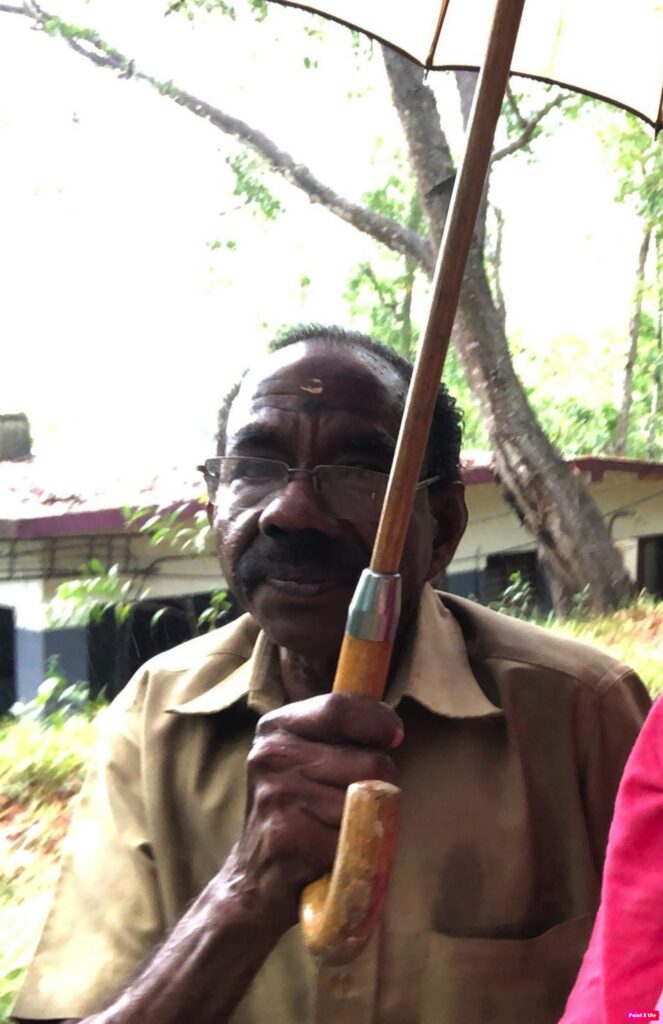
Keikei